

Cookie Consent in Ireland: What Your Business Website Needs

If your website uses analytics, advertising pixels or similar tracking, Irish law says you must get a visitor’s clear yes before those tools run, and you must explain them in plain language. A site that only uses cookies needed to make it work may not need a banner at all. The simplest route for a new business is to launch a website built with the right cookie setup from day one, rather than patching a banner on afterwards.
This guide explains the rule in ordinary terms, what a compliant banner has to do, how to work out which cookies your site uses, and what a cookie policy should say. It is written for sole traders, tradespeople and small business owners, not for lawyers.
TL;DR
- Under Ireland’s ePrivacy Regulations, you need consent before storing or reading information on a visitor’s device, unless it is strictly necessary for something the visitor asked for.
- Analytics and advertising cookies need consent first. Scrolling or carrying on browsing is not consent.
- A banner needs an accept option and an equally easy way to reject or manage choices, with nothing pre-ticked, and visitors must be able to change their mind later.
- A site that uses only strictly necessary cookies may not need a banner, but should still say what it uses.
- Decide what your site tracks before you build it. That keeps the banner simple and the policy short.
Table of Contents
- What the law says in Ireland
- Which cookies need consent and which do not
- What a compliant cookie banner must do
- Can you charge people to reject cookies?
- How to find out which cookies your site uses
- What your cookie policy should say
- A worked example: an electrician’s first website
- Perspective
- Getting it right from the start
- FAQ
- Sources
What the law says in Ireland
A cookie is a small file a website stores in a visitor’s browser. Other tools do the same job (pixels, local storage, device fingerprinting), and the law treats them together as “cookies and other tracking technologies”.
The rule comes from the ePrivacy Regulations, Regulation 5 of S.I. No. 336 of 2011. The Data Protection Commission (DPC), Ireland’s data protection regulator, explains in its guidance note on cookies that you need consent and clear, comprehensive information before storing information on, or accessing information from, a user’s device. There are two exceptions: technology used solely to transmit a communication, and technology that is strictly necessary to provide a service the visitor explicitly requested.
The DPC’s current guidance page adds what counts as valid consent: a clear, affirmative act that is freely given, specific, informed and unambiguous. In practice, that means the visitor clicks something that says yes. Silence, scrolling and a banner saying “by using this site you agree” do not qualify.
The General Data Protection Regulation (GDPR) sits alongside this. GDPR sets the standard for what “consent” means, and the ePrivacy rule says when you must ask. Both apply to Irish business websites.
Which cookies need consent and which do not
The test is not whether a cookie is yours or someone else’s. It is whether the website cannot deliver what the visitor asked for without it.
| Type of cookie or tool | Typical use | Consent needed before it runs? |
|---|---|---|
| Shopping-cart cookie | Remembers items in a basket | No, it can be strictly necessary |
| Security or load-balancing cookie that qualifies | Keeps the site working and secure | No, where it is strictly necessary |
| Analytics (including Google Analytics) | Counts visits and pages viewed | Yes |
| Advertising, targeting and conversion tracking | Ad pixels, remarketing | Yes |
| Embedded third-party content that sets cookies | Some video, map and social widgets | Usually yes, depending on what it sets |
The DPC’s FAQ confirms that a shopping-cart cookie can be strictly necessary, while targeted-advertising and conversion-tracking cookies are not exempt and require consent.
Analytics is the one that catches small businesses out. Many owners assume a basic visitor counter is harmless. The DPC’s list of exemptions is narrow, so plan on asking for consent before analytics run. If you use Google Analytics, our guide to Google Analytics 4 setup for Irish businesses walks through the configuration, and the GA4 basics and GDPR piece covers the privacy side.
Do you need a banner at all?
Not always. The DPC’s FAQ says a site using only cookies that do not require consent may not need a banner or a consent-management tool, though it recommends disclosing the strictly necessary cookies in a cookie policy or privacy notice.
This is useful for a brand-new brochure site. A simple site for a plumber or a hairdresser, with a contact form and no analytics or ad pixels, can be very light on tracking. The moment you add a Facebook pixel, a Google Ads tag or an analytics script, the banner becomes a legal requirement.
What a compliant cookie banner must do
A banner is the tool that collects and records the visitor’s choice. The DPC’s guidance sets out what it has to do:
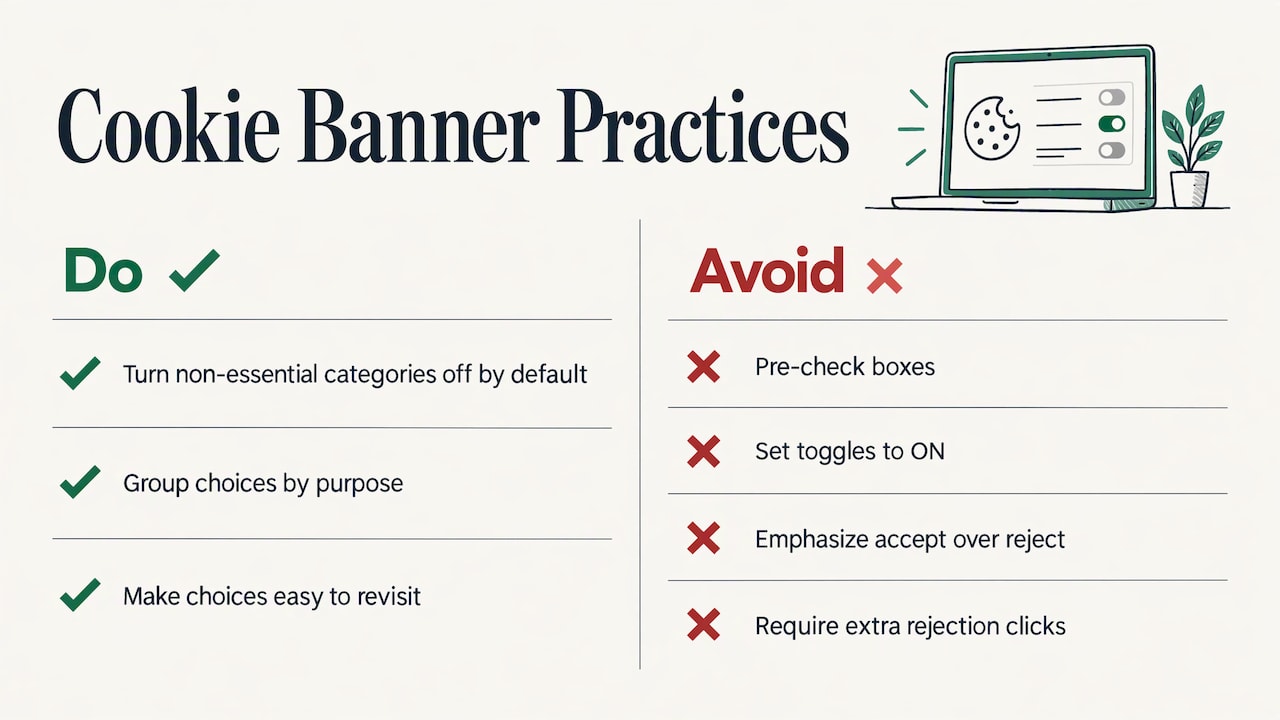
- Give a real choice. If there is an accept button, there must be an equally prominent reject option, or a manage option that leads to choices by cookie type and purpose.
- Rely on a clear action. Scrolling, silence, pre-ticked boxes and an accept-only “OK” button are not consent.
- Hold back the tracking. Non-essential cookies must not be set until the visitor agrees.
- Allow a change of mind. Visitors must be able to change or withdraw consent at any time as easily as they gave it, through a clear, accessible control.
All of these points are in the DPC’s April 2020 guidance note.
Where banners go wrong
The DPC’s FAQ on common problems it sees names pre-checked boxes and toggles set to “ON” and says consent obtained that way is invalid. Other typical faults are an “Accept all” button in bright colour with a pale grey text link for rejecting, or a reject route that needs three clicks while accepting needs one.
A useful model is the layout used by large Irish organisations. AIB’s privacy and cookies policy, effective 30 September 2026, describes four categories (Strictly Necessary, Performance, Functional and Marketing), with non-essential categories off by default and choices changeable at any time through an icon on the site. A small business does not need four categories, but it does need the same logic: off by default, grouped by purpose, easy to revisit.
Wording that works
Keep the text short and plain. Say who you are, what the cookies are for, and what each button does. Link to your cookie policy from the banner, and keep a link to it in the footer so visitors can find it after the banner has gone. That footer link is also a natural home for a “cookie settings” control that lets people change their choice.
Can you charge people to reject cookies?
This question comes up often. The short answer for a small business is that you should not make refusing a cookie costly or awkward. In its 22 October 2024 LinkedIn decision, the DPC said consent is invalid if a person has no real choice, feels compelled, or would suffer negative consequences for refusing, and noted that costs can be a form of detriment. That case concerned a very large platform, but the principle is the one to keep in mind: a visitor who says no should still get your website, your prices and your contact form.
How to find out which cookies your site uses
You cannot write a policy or configure a banner until you know what your site does. A simple audit takes less than an hour:
- List every tool you have added. Analytics, a chat widget, a map embed, a video player, social media feeds, an ad pixel, a booking plugin.
- Check what each one stores. Open your site in a private browser window, decline everything, then look at the cookies and stored data listed in your browser’s developer tools (under the Application or Storage tab). Anything that appears before you agree is a problem for non-essential tools.
- Note the purpose and lifespan. For each cookie, write down who sets it, what it is for and how long it lasts.
- Sort them. Strictly necessary, or needs consent. If you call something strictly necessary, be able to explain why the site cannot work without it.
- Remove what you do not need. Every tool you drop is one less line in your policy and one less thing to ask visitors about.
Repeat the audit whenever you add a plugin, change your analytics set-up or run a new ad campaign. Tracking tools tend to creep in unnoticed.
What your cookie policy should say
The DPC requires clear and comprehensive information about the technology and its purposes. A cookie policy is where that information lives. For a small business site it should cover:
- What cookies and similar technologies are, in a sentence or two.
- A table of the cookies you use: name, who sets it, purpose, how long it lasts, and whether it needs consent.
- Strictly necessary cookies, even if you do not need a banner for them, as the DPC recommends disclosing them.
- How to change or withdraw consent, with the control or link to use.
- Who to contact about your use of cookies.
Your cookie policy works hand in hand with your privacy policy, which covers how you handle personal data from forms, emails and enquiries. Our guides to a privacy policy for a business website in Ireland and the eight GDPR details for a small business privacy policy show what belongs in it. If your site collects enquiries, contact form best practices explain how to ask for only what you need.
A worked example: an electrician’s first website
Take a sole trader electrician in Cork with a five-page site: home, services, areas covered, reviews and contact. The site has an enquiry form and a WhatsApp button.
- Version one, no tracking. The site uses only the cookies needed to run it. Under the DPC’s FAQ, a banner may not be needed, but the electrician should still mention the necessary cookies in a short policy.
- Version two, with analytics. The electrician wants to see which pages bring enquiries and adds analytics. Now consent is required before it loads. The site needs a banner with accept and reject choices, analytics switched off until the visitor agrees, and a footer link to change the choice.
- Version three, with ads. A Google Ads campaign adds conversion tracking. That is also consent-based, so the banner and policy must list it.
Each step is manageable if planned. The trouble starts when tools are added one by one with no one checking what they set.
Perspective
Most new business owners we meet are not worried about cookies. They are worried about getting a site live, getting found and getting enquiries. Cookie consent only becomes a headache when it is bolted on at the end.
Our view is simple. Decide what you really need to measure before the site is built. A small service business often needs three things: a clear site, an enquiry route that works and a way to see where enquiries come from. Every extra tracking script adds a banner choice, a policy line and a thing to maintain.
That is why we build around a fixed quotation and direct contact with the person building your site. You can ask what each feature does, what it adds and whether you need it, in plain English and without jargon. When the site is live, our Website Care plans keep hosting, technical care and minor updates looked after, so changes to your site do not drift away from what your policy says.
Good cookie handling builds trust. A visitor who sees a clear, fair choice is more likely to feel they are dealing with a proper business.
niall
Getting it right from the start
If you are starting out, the cheapest time to get cookie consent right is while the site is being planned. Our Launch Website is €499 one-off, the Business Website is €799 one-off, and the Growth Website starts from €1,295 one-off. Website Care is €29 per month, covering ongoing hosting and technical care. Our services page lists enquiry and lead capture, local SEO foundations, Google Business Profile support and domain and business email setup, and our how it works page shows the process from first conversation to launch.
If your current site is out of date and you are not sure what it tracks, a website redesign and rebuild is a good moment to start clean.

FAQ
Does my small business website need a cookie banner?
It depends on what your site sets. If it uses only strictly necessary cookies, the DPC says a banner may not be needed, though you should still disclose those cookies in a policy. If you use analytics, advertising or other non-essential tracking, you need consent before they run, which in practice means a banner or consent tool.
Is Google Analytics allowed without consent in Ireland?
No. Analytics cookies are not on the DPC’s list of exempt cookies, so you need the visitor’s consent before they load. Set analytics to start only after a visitor accepts, and make sure the reject option works.
Is scrolling or continuing to browse valid consent?
No. The DPC says valid consent is a clear, affirmative act. A banner that treats scrolling, silence or pre-ticked boxes as agreement does not meet that standard.
How often should I review my cookie setup?
Review it whenever you add a tool, change your analytics or start an ad campaign, and check your cookie table matches what the site actually sets. Visitors must also be able to change their choice at any time through a control that stays available on the site.
Sources
- DPC guidance note on cookies and other tracking technologies (April 2020)
- DPC guidance on cookies and other tracking technologies
- DPC FAQ: do I have to get consent from users?
- DPC FAQ: does my website have to have a banner?
- DPC FAQ: common problems on websites
- AIB Privacy and Cookies Policy
- DPC decision on LinkedIn, 22 October 2024